
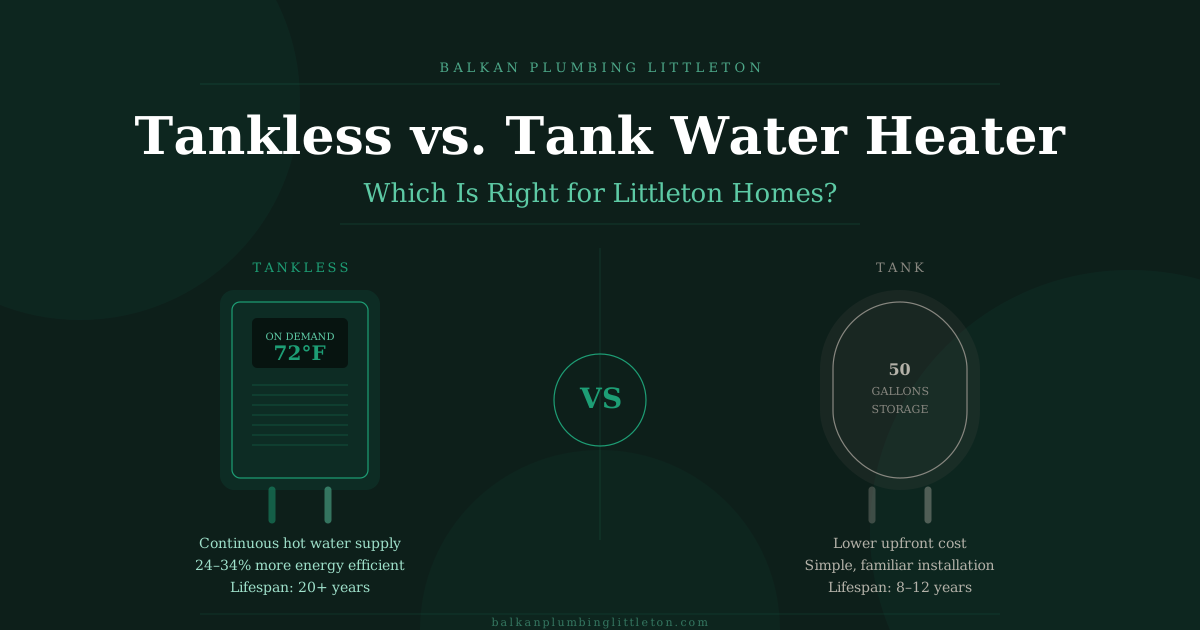

Understanding the Two Systems
Before comparing costs and efficiency, it helps to understand what each system actually does.
A tank water heater stores a fixed volume of water — typically between 40 and 80 gallons — and keeps it heated continuously, day and night. Whenever hot water is drawn from a tap, the tank refills and begins reheating. It is the standard in most American homes built before 2010.
A tankless water heater (also called an on-demand or instantaneous heater) has no storage tank. Cold water travels through a heating element only when a hot-water tap is opened, delivering a continuous stream on demand. Once the tap closes, the unit stops operating entirely.
Tankless Water Heater
- Heats water only when needed
- Continuous hot water supply
- Higher upfront cost
- Longer lifespan (20+ years)
- Lower monthly energy bills
- Compact, wall-mounted design
Tank Water Heater
- Stores preheated water
- Limited by tank capacity
- Lower upfront cost
- Shorter lifespan (8–12 years)
- Standby energy loss daily
- Requires dedicated floor space
Energy Efficiency: Where the Real Difference Lies
Tank water heaters lose heat throughout the day through a phenomenon known as standby heat loss. The unit must constantly fire up to maintain water temperature — even at 2 a.m. when no one in the household needs hot water. For Littleton homeowners dealing with cold Colorado winters, this inefficiency is compounded as units work harder to compensate for ambient temperature drops.
Tankless units eliminate standby heat loss entirely. According to the U.S. Department of Energy, tankless water heaters can be 24–34% more energy efficient than conventional storage-tank models for homes that use 41 gallons or less of hot water daily. For homes with higher demand, efficiency gains of 8–14% are still typical.
Over a decade of use, the energy savings from a tankless system often offset its higher purchase price — particularly in a region like Littleton where utility costs trend upward year over year.
Upfront Cost vs. Long-Term Value
The most common objection to tankless water heaters is their higher purchase and installation price. A standard tank unit typically runs between $300 and $900 for equipment alone. A quality tankless model — especially a whole-home gas unit — can cost $1,000 to $3,000 before installation.
However, the comparison does not stop at the initial invoice. Consider the full ownership picture:
Lifespan: Tank heaters last 8 to 12 years on average. Tankless units regularly reach 20 years or more with routine maintenance. A homeowner who installs a tankless unit may never need to replace it again while living in that property.
Energy savings: Lower monthly utility bills accumulate meaningfully over time. For a household spending $50/month on water heating, a 25% reduction equals $150 saved annually — $3,000 over 20 years.
Space: Tankless units are wall-mounted and compact. Removing a bulky 50-gallon tank can free up significant space in a utility room, basement, or garage.
For new homebuyers and property managers operating multiple units, the long-term return on investment often makes tankless the financially sound choice.
Performance: Hot Water on Demand vs. Running Out
One of the most frustrating household experiences is running out of hot water mid-shower. With a tank system, this happens when demand exceeds the tank’s capacity — a real concern in larger households or properties with multiple simultaneous users.
Tankless systems eliminate this limitation. Hot water is generated continuously as long as the tap is open. That said, tankless units do have a flow rate ceiling — the maximum number of gallons per minute (GPM) the unit can heat simultaneously. A single-bathroom home or apartment has very different needs than a four-bedroom house with two bathrooms running at once.
Sizing a tankless unit correctly is critical. Undersizing the unit leads to lukewarm water during peak demand. This is why professional assessment and tankless water heater installation — rather than a DIY approach — is strongly recommended for Littleton homeowners making this switch. Our team at Balkan Plumbing Littleton evaluates each home’s specific demand profile before recommending a unit size.
What Works Best for Littleton’s Climate?
Littleton sits at over 5,300 feet in elevation, with cold winters and significant temperature swings between seasons. These factors affect water heater performance in ways that matter.
Incoming groundwater in Colorado is colder than in southern states — sometimes significantly so in winter months. Tankless units must raise that cold incoming water to a usable temperature within seconds. A unit that performs well in Florida may underperform in Littleton if it lacks the BTU capacity to handle the temperature differential. Gas tankless units generally handle Colorado’s cold groundwater more effectively than electric models, which can struggle with high flow rates at low incoming temperatures.
Tank heaters are less sensitive to incoming water temperature since they maintain a full reserve at all times — but they also work harder and consume more energy during cold months to counteract ambient temperature loss in unheated spaces like garages or crawl spaces.
Maintenance Requirements
Both systems require maintenance, but the nature of that maintenance differs.
Tank water heaters accumulate sediment at the bottom over time — a natural result of minerals in the water supply. In areas with hard water (which Littleton can experience), this buildup accelerates, reducing efficiency and shortening the unit’s lifespan. Annual flushing and periodic anode rod replacement are standard maintenance tasks.
Tankless units require descaling — flushing the heat exchanger with a vinegar or citric acid solution — typically once a year, more frequently in hard-water areas. Some units also benefit from a water softener upstream. Neglecting this maintenance can lead to mineral buildup that reduces heat transfer and eventually damages the unit.
Neither system is maintenance-free. However, with proper care, a tankless unit’s maintenance costs over its 20-year lifespan typically remain comparable to — or less than — two tank heater replacements over the same period.
Which Option Is Right for Your Situation?
There is no universal answer, but these guidelines apply to most Littleton households:
Choose a tankless water heater if: the home has consistent hot water demand, energy efficiency is a priority, space is limited, or the property is a long-term investment where lifecycle cost matters more than upfront expense.
Choose a tank water heater if: the budget for installation is tight, the home is a short-term rental or transitional property, or a simple, low-complexity replacement is needed quickly.
For property managers overseeing multiple units, tankless heaters in each unit can reduce energy overhead and eliminate tenant complaints about hot water supply — a compelling operational argument on its own.
Not sure which system is right for your Littleton property? The licensed plumbers at Balkan Plumbing Littleton assess your home’s demand, water quality, and budget before recommending a solution — with no guesswork.
Frequently Asked Questions
Can a tankless water heater handle an entire Littleton home?
Yes — when properly sized. A whole-home gas tankless unit with sufficient BTU output and GPM rating handles simultaneous demand from multiple fixtures. Proper sizing by a licensed plumber is essential.
How long does it take to recoup the cost of a tankless unit?
For most Littleton households, the payback period falls between 5 and 10 years, depending on energy costs, usage volume, and the efficiency rating of the unit selected.
Is a permit required to replace a water heater in Littleton, CO?
Yes. Water heater replacements in Littleton require a permit and must meet local building codes. A licensed plumber handles permitting as part of a compliant installation.
What happens if a tankless unit is too small for my home?
An undersized unit produces lukewarm water when multiple taps run simultaneously. This is one of the most common installation errors — and one of the strongest reasons to work with experienced local plumbers rather than attempting a DIY replacement.
Final Thoughts
Both tank and tankless water heaters serve Littleton homes well — when chosen and installed correctly. The decision comes down to your property’s specific demand, your budget horizon, and how long you plan to stay in the home. Short-term thinking favors the lower upfront cost of a tank unit. Long-term thinking — accounting for energy savings, lifespan, and reliability — increasingly favors tankless.
Whatever the decision, professional installation matters. An incorrectly sized or improperly vented unit creates problems that cost far more to fix than the savings gained from cutting corners. Explore water heater installation services in Littleton from a team that knows Colorado homes.