
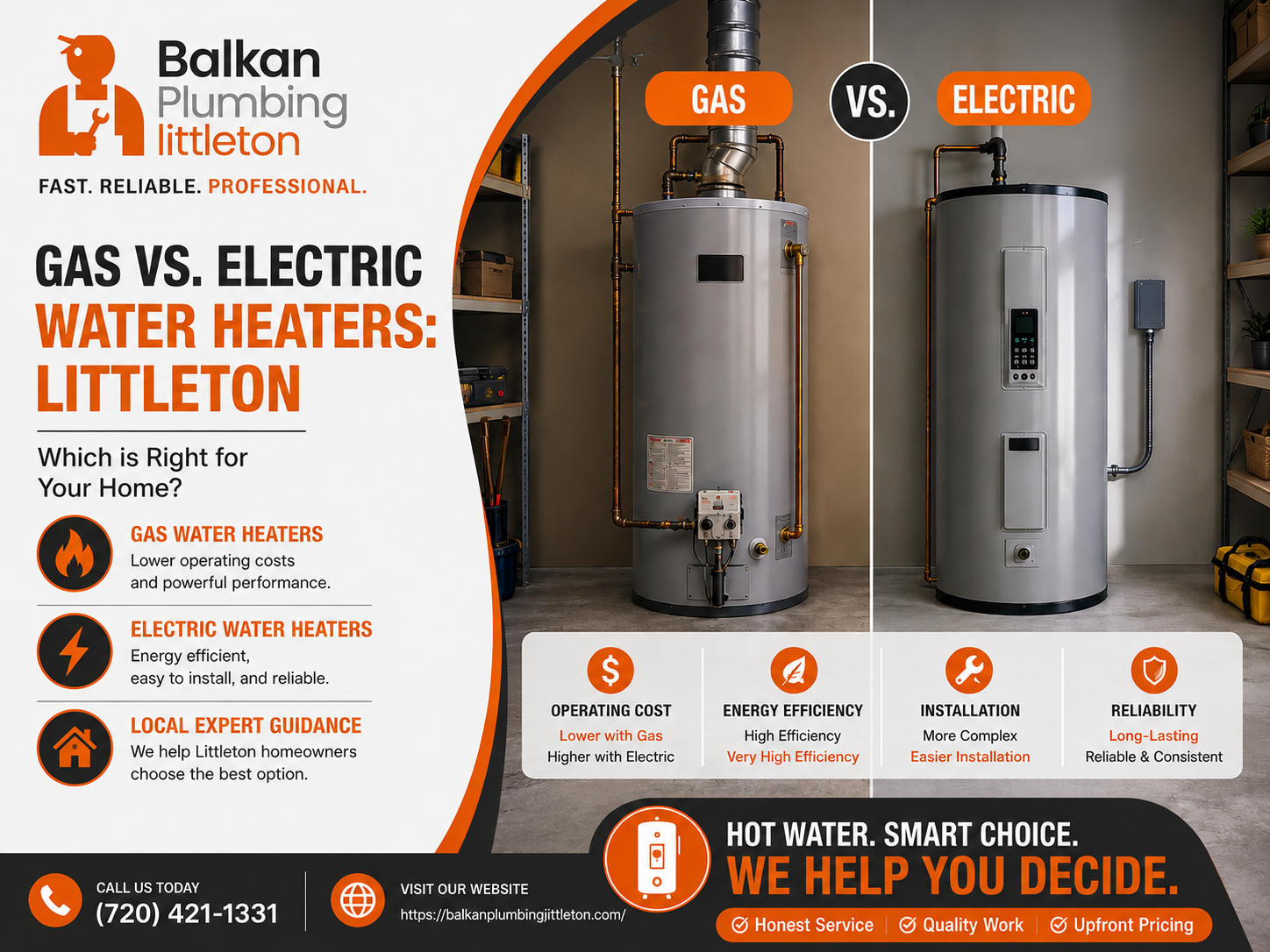

If you’re comparing options for water heater installation in Littleton, the gas-vs-electric decision is usually the first fork in the road. Both types get the job done, but they behave differently in Colorado’s climate, cost different amounts to run on Xcel Energy rates, and require different setups in your home.
Here’s a straight answer, followed by everything you need to make the right call for your household.
In This Article
How Gas and Electric Water Heaters Work
A gas water heater burns natural gas or propane at a burner beneath the tank to heat water, then vents the exhaust outside through a flue. An electric water heater uses one or two heating elements submerged directly in the tank, powered by a dedicated 240-volt circuit — no combustion, no venting.
That single difference in how each unit generates heat is what drives almost every other difference between them: cost, speed, safety requirements, and installation complexity.
Cost Comparison: Upfront and Monthly
Electric units are cheaper to buy and install, but gas units usually cost less to run every month. Here’s how the numbers typically break down for a standard 40-50 gallon tank.
| Factor | Gas Water Heater | Electric Water Heater |
|---|---|---|
| Unit + Install Cost | Higher — requires gas line and venting | Lower — no venting needed |
| Typical Annual Operating Cost | Roughly $225-$475/year | Roughly $400-$600/year |
| Energy Efficiency | 60-70% (standard models) | 90-95% |
| Works During Power Outage | Yes, if gas supply is uninterrupted | No |
| Typical Lifespan | 8-12 years | 10-15 years |
These figures shift based on your household’s actual hot water use and current Xcel Energy gas and electric rates, which is why a home-specific estimate matters more than a national average.
Efficiency and Recovery Rate
Efficiency and speed pull in opposite directions here, and it trips a lot of homeowners up.
Electric water heaters are more efficient in a technical sense — they convert 90-95% of the energy they use directly into hot water, with almost nothing lost. Gas water heaters are faster — because they don’t rely on slower resistance coils, they typically recover 30-45 gallons of hot water per hour, compared to 14-20 gallons per hour for electric.
In practice, that means a gas unit is less likely to leave you waiting for hot water to refill after back-to-back showers or a full load of laundry — which matters more in larger Littleton households than efficiency percentages do.
Not Sure Which System Fits Your Home?
Our team evaluates your household size, existing gas or electric setup, and hot water demand before recommending anything — not just the option that costs the most.
Littleton-Specific Factors to Consider
A few local realities affect this decision more than most national buying guides mention:
Elevation and combustion venting. Littleton sits at roughly 5,350 feet. Higher elevation affects gas combustion efficiency and venting requirements, which is why gas water heater installations here need correct sizing and venting for altitude — not a generic install done the same way it would be at sea level.
Hard water and sediment. Colorado’s mineral-heavy water builds up sediment inside tank-style heaters of either fuel type, gradually reducing efficiency and shortening lifespan. Gas units are somewhat more exposed since sediment sits directly above the burner, insulating it and forcing it to work harder.
Winter demand swings. Incoming water temperature drops in winter, which means your water heater works harder to reach the same output temperature. Gas units generally handle that seasonal swing with less noticeable slowdown than electric units.
Existing home setup. If your Littleton home already has a gas line and vent in place, staying with gas is usually the more cost-effective choice. Converting from electric to gas — or the reverse — adds real cost for new gas lines, venting, or a dedicated 240V electrical circuit.
Which Type Is Right for Your Household?
Gas is usually the better fit if:
- Your household has 4+ people or high simultaneous hot water demand
- You already have a gas line and venting in place
- You want backup hot water access during power outages
- Lower monthly operating cost matters more than upfront price
Electric is usually the better fit if:
- You’re in a smaller home or condo with lower hot water demand
- Your home doesn’t currently have gas service
- You want the lowest possible installation cost
- You’re prioritizing energy efficiency over recovery speed
For a full breakdown of every water heater type available — including heat pump models — see our guide to choosing the right water heater system for your Littleton home.
Don’t Forget the Tankless Option
Both gas and electric water heaters are also available in tankless form, which heats water on demand instead of storing it in a tank. Gas tankless units are the more common upgrade path in Littleton, offering continuous hot water and lower standby energy loss compared to a tank system — though they come with their own installation requirements around gas line sizing and venting.
If endless hot water and long-term savings matter more to you than upfront cost, it’s worth having a technician evaluate whether a tankless water heater installation in Littleton makes more sense than a traditional tank replacement.
Frequently Asked Questions
Is it cheaper to run a gas or electric water heater?
Gas water heaters typically cost less to run monthly, often $225-$475 per year versus $400-$600 for electric, since natural gas is generally cheaper per unit of energy than electricity in most Colorado markets.
Which lasts longer, gas or electric water heaters?
Electric water heaters typically last 10-15 years, slightly longer than gas units at 8-12 years, largely because they have fewer moving parts and no burner or venting components to wear down.
Can I switch from electric to gas water heater, or vice versa?
Yes, but it requires a licensed plumber and often an electrician to run new gas lines, add proper venting, or install a dedicated 240V circuit — this isn’t a simple swap and should be professionally assessed first.
Does a gas water heater work during a power outage?
Yes, as long as your gas supply is uninterrupted, since gas units don’t rely on electricity to heat water — though some models use an electric igniter or control board that may still need power.
Which is better for a large family, gas or electric?
Gas is generally better for larger households because it recovers hot water faster — typically 30-45 gallons per hour versus 14-20 gallons per hour for electric — reducing the chance of running out of hot water.
Do electric water heaters need venting?
No. Electric water heaters don’t produce combustion byproducts, so they don’t require a flue or venting system, which simplifies installation compared to gas units.
How much does water heater installation cost in Littleton, CO?
Cost depends on unit type, tank size, and whether new gas, venting, or electrical work is needed — an in-home assessment gives the most accurate number for your specific setup.
Ready for a New Water Heater in Littleton?
Whether you’re leaning gas, electric, or tankless, Balkan Plumbing Littleton gives you an honest, no-pressure recommendation based on your household — not the priciest option. Licensed, insured, and local.
📞 Call (720) 421-1331 to schedule your water heater installation
Sources: U.S. Department of Energy – Water Heating
|
About Balkan Plumbing Littleton Balkan Plumbing Littleton is a licensed and insured plumbing contractor serving Littleton, CO and the greater Denver metro area, specializing in water heater installation, repair, and whole-home plumbing services. |